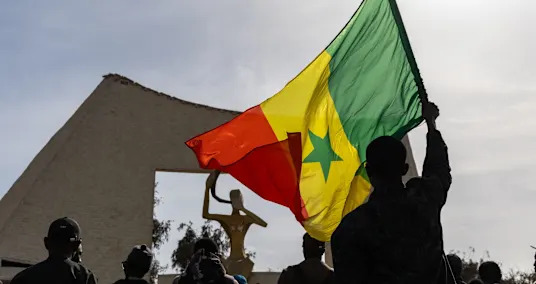
Senegal's President Bassirou Diomaye Faye has signed a new law doubling to 10 years the maximum prison term for sexual acts by same-sex couples.
The new law also criminalises the "promotion" of homosexuality, which includes any public representation and financial support by individuals or organisations, and provides for three to seven years in prison for those found guilty.
The legislation was a campaign promise of President Faye and Prime Minister Ousmane Sonko and was approved by parliament last month.
UN rights chief Volker Türk has described it as "deeply worrying", saying that the anti-LGBT legislation "flies in the face of sacrosanct human rights".
The UN official and rights groups had urged the president not to sign it into law, but the government dismissed the international criticism, arguing that the measures reflected the views of Senegalese people.
It was taken to parliament after a wave of arrests over alleged same‑sex relationships, which were already banned under Senegalese law.
In February, 12 men, including two public figures and a journalist, were arrested and charged with "acts against nature".
Campaign group Human Rights Watch has recently noted a rise in "hostility toward LGBT people", adding that MPs had twice – in 2022 and 2024 - unsuccessfully sought to raise jail terms and penalties against same-sex relationships.
The new law was passed by an overwhelming majority in the National Assembly on 11 March, with 135 MPs voting in favour, none against and three abstaining.
Several other African countries have also introduced tough new laws against the LGBTQ+ community in recent years.
In September last year, Burkina Faso's transitional parliament approved a bill banning homosexual acts, following its neighbour Mali in 2024.
In 2023, Uganda voted in some of the world's harshest anti-homosexual legislation, meaning that people engaging in same-sex relationships can be sentenced to death in certain circumstances.
Ghana is also planning to re-introduce an anti-homosexual bill that activists say threatens basic human rights, safety and freedom.
You may also be interested in:

Go to BBCAfrica.com for more news from the African continent.
Follow us on Twitter @BBCAfrica, on Facebook at BBC Africa or on Instagram at bbcafrica
BBC Africa podcasts
LATEST POSTS
- 1
 UAE-backed Yemeni Southern Transitional Council denies disbandment rumors
 - 2More parents refusing vitamin K shots for newborns, study finds
- 3The best ice packs for coolers of 2026, tested and reviewed
- 4Vote In favor of Your Favored Menial helper Administration
- 5Computerized Moderation: Tracking down Equilibrium in the Advanced Age





- What happened to Eleven after the ambiguous 'Stranger Things' series finale? Millie Bobby Brown knows — but 'swore herself to secrecy'
- All the ways Marjorie Taylor Greene has shifted her approach lately — and why Trump is 'surprised at her'
- 6 Popular Men's Aromas On the planet
- Extraordinary Snowboarding Objections All over the Planet
- Olivia Rodrigo announces 3rd album, 'You Seem Pretty Sad for a Girl So in Love,' set to debut in June
- Guns N' Roses 2026 Tour: How to get tickets, presale times, prices and more
- An Artemis 2 astronaut took a 'bath' on camera on the way to the moon. Mission Control's reaction was priceless (video)
- A red meat allergy from tick bites is spreading – and the lone star tick isn’t the only alpha-gal carrier to worry about
- Discovering a sense of harmony: Individual Accounts of Reflection and Care