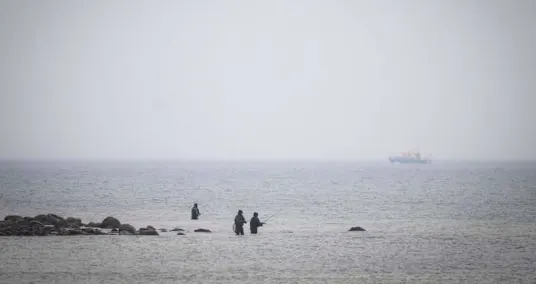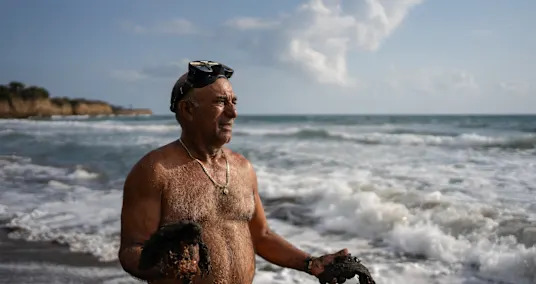
MEXICO CITY (AP) — An oil spill in the Gulf of Mexico in early March spread more than 600 kilometers (373 miles), including to seven nature reserves, and originated from a vessel yet to be identified and two “natural seepages,” Mexican authorities announced Thursday.
Authorities, however, ruled out the possibility of severe environmental damage from the spill off coast of the eastern state of Veracruz.
The release of the preliminary findings came after weeks of controversy surrounding the lack of transparency in the case.
Navy secretary, Admiral Raymundo Morales, said satellite image analysis and inspections of the area identified three sources of the spill: a vessel anchored off the coast of the port city of Coatzacoalcos, in the eastern state of Veracruz; a geological site where crude oil naturally seeps, known as a “chapopotera,” located 8 kilometers (5 miles) from that port; and another natural seepage located in the Bay of Campeche.
Morales said at a press conference that the vessel has not yet been identified because, as of early March, there were 13 ships sailing in the area that had not yet been inspected.
He also admitted that the source of the spill “remains active,” and that one of the main sources is estimated to be the “natural seeps in Cantarell, in the Bay of Campeche.”
“These oil seeps have a constant, natural emission; however, there has been a greater flow of contaminants in the last month,” he said.
Five months earlier, heavy rains and flooding caused a pipeline rupture and a spill, also in Veracruz, that extended for 8 kilometers (5 miles) along the Pantepec River.
In the March spill, Morales reported that the oil covered an area of about 600 kilometers (373 miles) including 200 kilometers (125 miles) of coastline in the southern states of Veracruz and Tabasco. To date, “430 tons of hydrocarbons” have been collected.
Secretary of the Environment Alicia Bárcena reported that the spill affected seven protected natural reserves in the states of Veracruz and Tabasco, but insisted that “we have not detected severe environmental damage.”
Environmental authorities have identified six species, including sea turtles, birds and fish, that were contaminated by the spill.
The National Commission of Natural Protected Areas (Conanp) reported Wednesday in a statement that hydrocarbons have been collected in the Los Tuxtlas Biosphere Reserve, the Veracruz Reef System National Park, the Lechuguillas Sanctuary, the Totonacapan Beaches Sanctuary, the Lobos Tuxpan Reef System Flora and Fauna Protection Area, and south of the Rancho Nuevo Beach Sanctuary in the state of Veracruz. Cleanup efforts were also carried out in the Centla Wetlands Biosphere Reserve in the state of Tabasco.
The international organization Oceana, dedicated to ocean conservation, said this week in a statement that, according to reports from communities belonging to the Gulf of Mexico Reef Corridor Network, the spill killed sea turtles, a manatee and various fish species, and damaged 17 reefs.
___
Follow AP’s Latin America coverage at https://apnews.com/hub/latin-america
LATEST POSTS
- 1
 One spent $20 on candy. Another paid $700 for a custom costume. Here's how Halloween costs stacked up this year.
 - 2Chris Noth responds to backlash after seemingly shading 'Sex and the City' costar Sarah Jessica Parker: 'It is not news'
- 3Fire Allegedly Triggered by Wedding Cake Sparkler Causes Venue to Go Up in Flames, Leaving Groom with Second-Degree Burns
- 4Manual for Purchasing a Modest Jeep Wrangler for Seniors
- 5IDF uncovers 7 km.-long Gaza terror tunnel where Hamas held Hadar Goldin


- Chinese mega embassy could bring security advantages, says No 10
- The 15 Most Motivating TED Discusses All Time
- Christmas 2025 skywatching guide: What you can see in the night sky on Dec. 25
- Argentina reportedly delaying embassy move over Israeli company's oil project near Falklands
- Whale stranded off Germany for days is stuck again
- Ryan Gosling responds to Deidre Hall's invitation to visit the 'Days of Our Lives' set: 'This is a very enthusiastic yes'
- IDF continues counterterrorism operations in Gaza Strip, including destroying terror tunnels
- Step by step instructions to Open a Lovely Waterway Voyage Insight: Conveniences, Administrations, and Elite Offers
- Jury says Johnson & Johnson owes $40 million to 2 cancer patients who used talcum powders