Additional discoveries made a the site included a bronze candelabrum and marble reliquary, both the largest of their kind to ever be found in Israel.
A marble block with three half-sphere depressions was found beside a baptismal font, thought to possibly point to a lost stage of early Christian baptismal rites, was found in the ancient city of Hippos, not far from the Kinneret, according to a recent study.
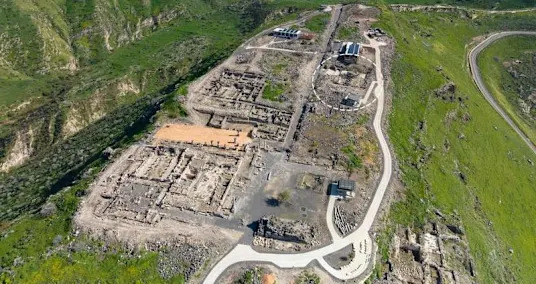
The artifact, unlike anything previously documented in archaeological record, was discovered during excavations focused on a newly unearthed ceremonial hall annexed to the south of Hippos’s cathedral. Inside, archaeologists found a partially preserved room housing a baptismal font and several other liturgical objects.
“Only after careful research did we realize how unique they are for understanding Christian ritual practices in the cradle of Christianity by the Sea of Galilee,” said Dr. Michael Eisenberg of the Zinman Institute of Archaeology and Haifa University, one of the leaders of the excavation.
Currently, researchers' leading theory regarding the artifact’s use is that it was meant to hold three different oils used during the threefold baptismal immersion ceremony, rather than the two anointings in the pre- and post-baptism.
Evidence further suggests that the ceremonial hall was constructed after 591 CE and later destroyed during an earthquake in 749 CE, which buried the artifacts beneath heavy rubble leading to their preservation.

Additional discoveries made a the site included a bronze candelabrum and marble reliquary, both the largest of their kind to ever be found in Israel.
Ancient Hippos: Only Christian Byzantine city on the Kinneret
Hippos was the only Christian city around the Kinneret during the Byzantine age, controlling a broad swath of territory including the southern Golan and the Kinneret’s eastern shore, an area Christian tradition associates with the ministry of Jesus.
As such, the cathedral of Hippos, one of approximately seven churches to have operated within the city at the time, became the most prominent ecclesiastical place of worship in the region.
It is also the only known church to have had two designated halls, or photisterion (“hall of illumination”), with baptismal fonts. The photisterion previously excavated at the site is the largest known among Byzantine churches in Israel.
According to researchers, the larger hall was used primarily for adult baptisms, while the second, recently discovered hall was used for the baptisms of infants and children.
“Baptism was one of the central rites of Christian communal life and gradually took shape during the Byzantine period,” Eisenberg concluded. “In different regions, distinct liturgical traditions developed, many of which are not documented in written sources.”
“This find offers a rare glimpse into how the baptismal rite was shaped and practiced in the Byzantine Christian community of Hippos.”
The complete findings were published by Dr. Michael Eisenberg and Dr. Arleta Kowalewska in an early March edition of the Palestine Exploration Quarterly.
LATEST POSTS
- 1
 Evaluated Smartwatches for Wellness Devotees
- 2Novo Nordisk justifies reasoning behind failed GLP-1 Alzheimer's trials
- 3Fundamental Home Exercise center Hardware: Amplify Your Exercises
- 4The cave was pitch black – so to create this magical underwater shot, the photographer had to use all his camera expertise...
- 5Watch This Glacier Race into the Sea


- The most effective method to Decide the Best Auto Crash Attorney for Your Lawful Necessities
- What is a Trump Gold Card? U.S. launches $1 million immigration visas
- Thousands of genomes reveal the wild wolf genes in most dogs’ DNA
- Two reportedly killed as Israel attacks Hezbollah targets in Lebanon
- The Leonid meteor shower is peaking early this week. Here’s what to know
- Congo declares its latest Ebola outbreak over, after 43 deaths
- Ukrainian man arrested in Germany on suspicion of spying for Russia
- I'm an 83-year-old yoga instructor. I'm not your typical grandma — I still work to feel fulfilled and supplement my Social Security.
- CDC vaccine panel votes to remove universal hepatitis B birth dose recommendation


